

How Automated Registration is Used for Print Inspection
In modern manufacturing, especially in high-speed printing industries, quality control is increasingly dependent on automation. One of the key advancements in this area is automated registration in print inspection, a technology that is designed to make sure precise alignment, steady consistency, and defect detection across printed materials happen more reliably.
Registration in printing is basically the alignment of different color layers or print elements. Even tiny misalignment can cause blurred images, color drift, or text that feels difficult to read. Automated registration systems help remove these issues by continuously watching the process and adjusting alignment in real-time during production.
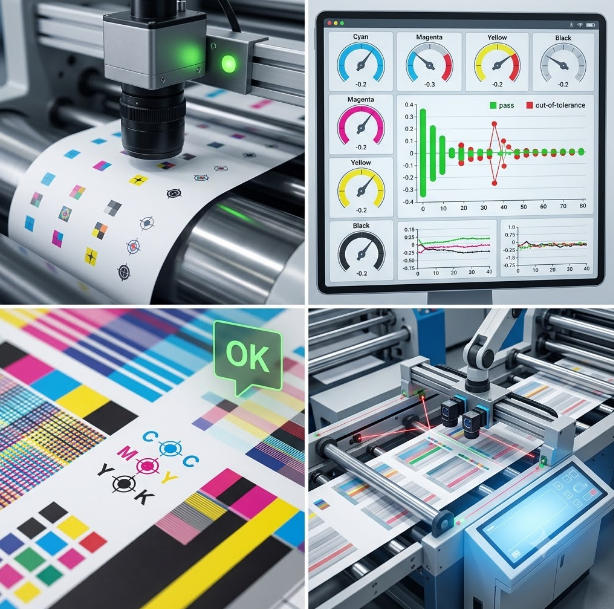
Table of Contents
What is Automated Registration in Print Inspection
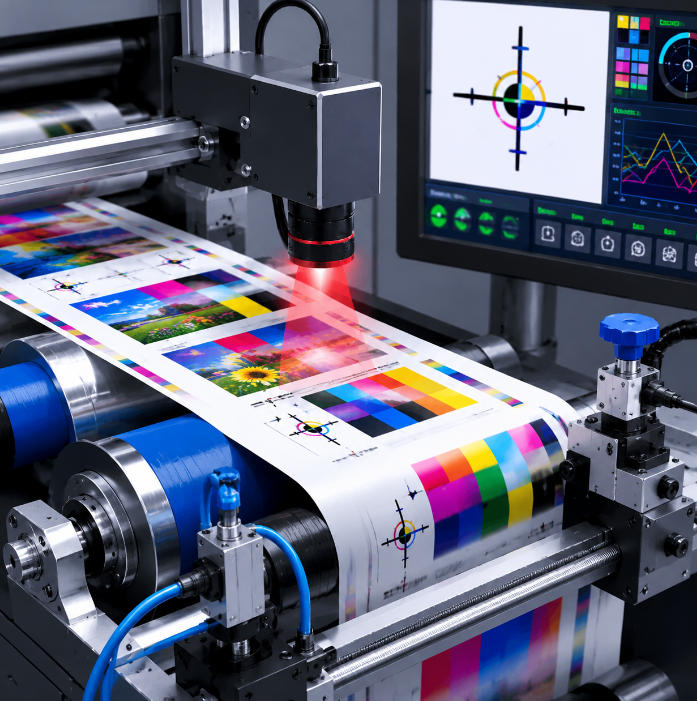
Automated registration in print inspection is basically a digital control process that uses sensors, cameras, and software algorithms, to detect positional variations between printed layers or patterns. When misalignment is detected the system automatically tweaks the printing cycle, such as ink application timing, plate placement, or substrate feed speed, to bring things back to accuracy.
Unlike manual inspection, which depends on human watching and occasional sampling, automated 100% inspection systems offer continuous monitoring while production keeps running at speed, so they become essential for large volume printing jobs.
Why Automated Registration is Needed in Print Inspection
1. Improving production efficiency
One of the main reasons automated registration is needed is its ability to cut down material waste a lot. In traditional systems, misalignment often causes large batches of defective prints that have to be discarded or reworked, again and again. Automated web inspection systems for printing quality lower that hazard right away, because they correct the problem immediately. This not only saves raw materials like paper, ink, and film, but it also trims machine downtime, connected to stopping and restarting production. Because of that, overall production efficiency gets better, quite noticeably.
2. Ensuring Consistency in High-Volume Production
Consistency is a crucial requirement in areas like packaging, labeling, and commercial printing. Products must keep a uniform look across large runs so they can satisfy brand expectations and regulatory rules.
Automated registration makes sure that every printed unit remains the same, even when production speed changes a little, or the environment acts differently. You can not really get this kind of steadiness with manual control by itself, particularly during long continuous runs, where small drifts tend to show up later.
3. Supporting Complex Multi-layer Printing Processes
Modern printing frequently uses more than one layer of ink, and each layer needs accurate placement. In flexographic and offset printing, for example, even a tiny misalignment between layers can disturb the final appearance.
With automated registration systems, the layers get synchronized continuously, so each color and pattern ends up lining up just right. That result matters a lot for high-resolution graphics, plus security printing applications.
Enhancing Operator Efficiency
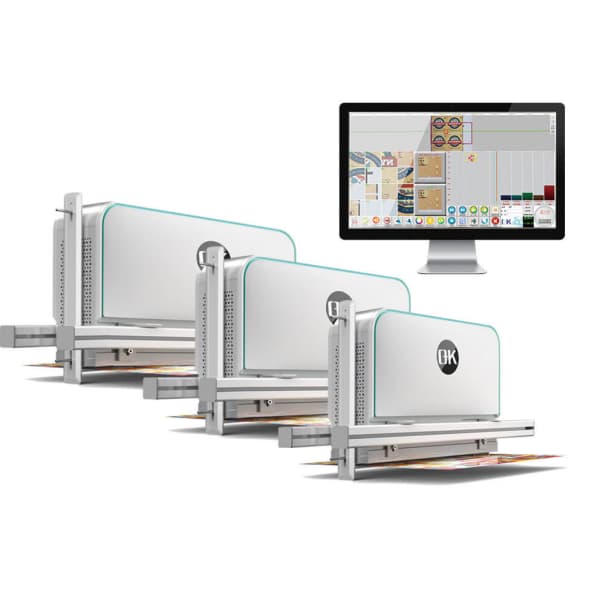
By automating the registration process, operators are freed from constant monitoring and adjustment tasks. Instead of manually correcting alignment, they can focus on higher-level supervision and process optimization. This reduces operator fatigue and boosts overall workplace efficiency. It also lowers the likelihood of human error impacting print quality.
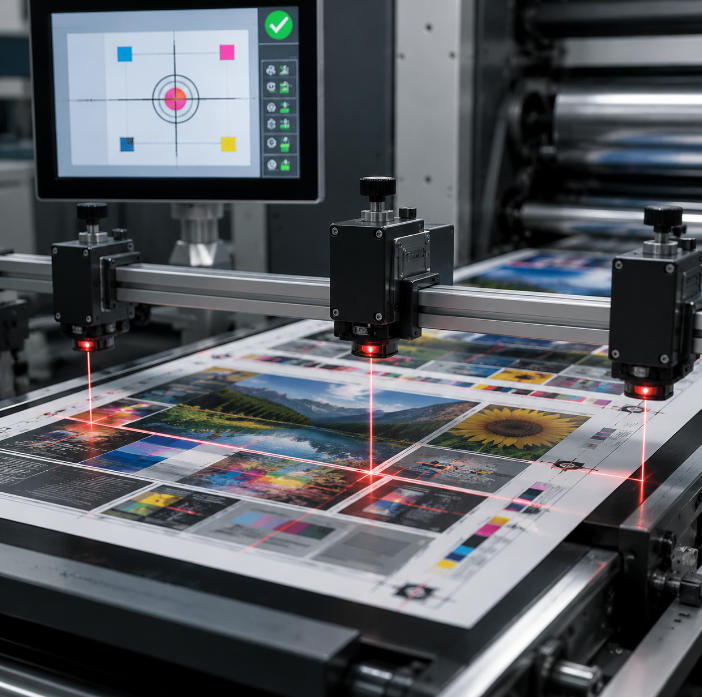
How Automated Registration System Works in Print Inspection
Automated registration systems get used in print inspection to continuously observe and correct alignment during production. They run in real time, so printing lines can keep high speed without losing accuracy
1. Image Acquisition and Real-Time Monitoring
The process starts with image acquisition, like the system is looking at the material first. High-speed cameras or optical sensors get installed along the printing line, so they can capture continuous images as the substrate keeps moving. These imaging systems are meant to work in industrial conditions, so they are expected to deal with fast travel speeds, plus surface properties that may change.
While the material goes through the press, the setup grabs repeated snapshots of predefined registration marks, or certain printed features that were chosen earlier. The pictures then become the working foundation for checking alignment accuracy in real-time. Capture speed, together with precision, matters a lot because even small delays can cause correction signals that do not match what is actually happening, and then the next prints suffer.
2. Pattern Detection and Deviation Calculation
Once images are captured, the printing inspection system moves into pattern detection, digital comparison and error analysis.
| Stage | Key Process | Description | Output | Importance |
| Preprocessing | Image enhancement and normalization | Removes noise, adjusts brightness/contrast, and stabilizes images for accurate detection | Cleaned image data | Improves detection accuracy under industrial conditions |
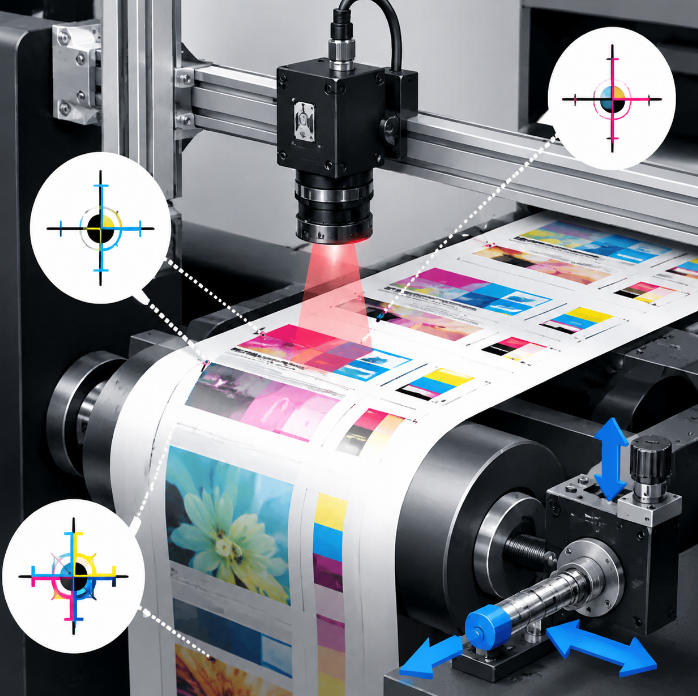
| Feature Identification | Detection of registration marks | Software identifies predefined patterns such as crosses, dots, edges, or color markers | Located reference points | Establishes measurable alignment anchors |
| Template Matching | Digital reference comparison | Captured features are compared with stored ideal layout templates | Alignment deviation data | Enables precise positioning analysis |
| Position Calculation | Spatial analysis of features | System calculates X-Y shifts, rotation angles, and scaling differences | Numeric deviation values | Quantifies misalignment between layers |
| Color Layer Correlation | Multi-layer alignment analysis | Compares alignment between different color separations (CMYK or specialty inks) | Layer-to-layer offset data | Ensures accurate multi-color registration |
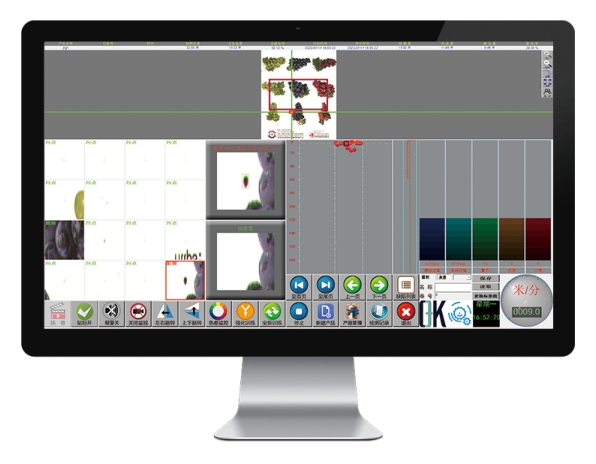
3. Automatic Correction Mechanism
Once the deviation is calculated, the system sends correction signals to the printing machine. These signals adjust mechanical or digital components such as servo motors, print head positions, or substrate feed mechanisms. The goal is to compensate for the detected error before it affects subsequent prints.
Because the 100% print inspection system operates in a closed feedback loop, corrections are applied continuously. Each adjustment is followed by another round of image capture and analysis, ensuring that the system remains stable even when production conditions change.
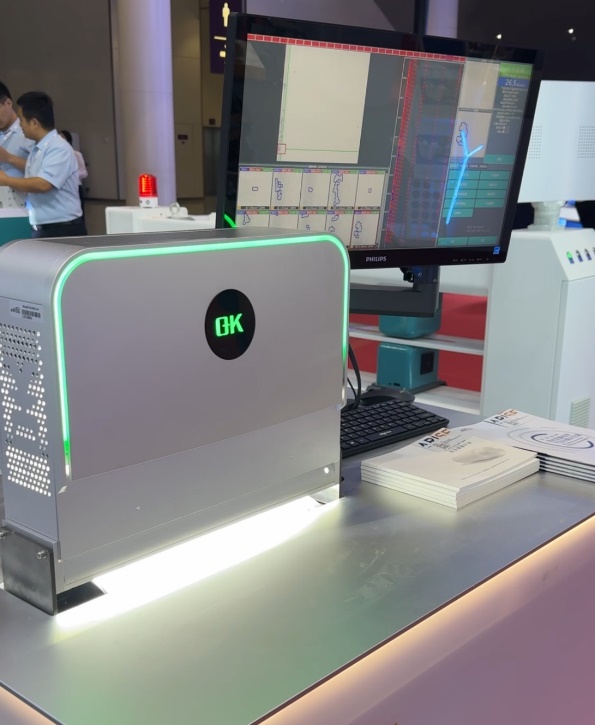
4. Feedback Loop and Continuous Stability
The feedback loop is the core of automated registration. It ensures that monitoring, analysis, and correction occur repeatedly and without interruption. This continuous cycle allows the system to respond immediately to variations caused by material stretch, temperature changes, or mechanical vibration.
Over time, the full-surface printing inspection system learns to maintain stability within predefined tolerance limits, reducing fluctuations and improving overall print consistency.
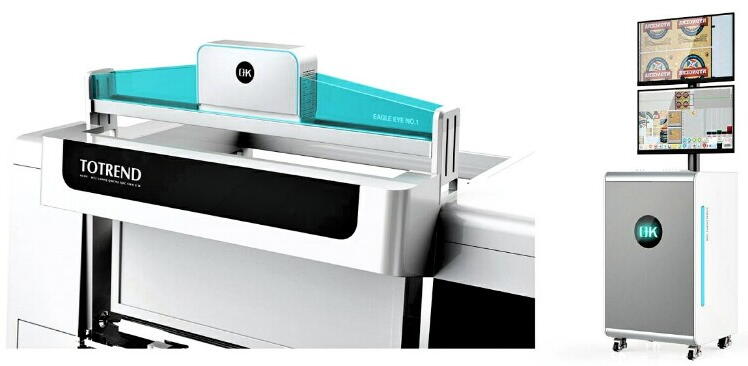
5. Integration with Printing Press Systems
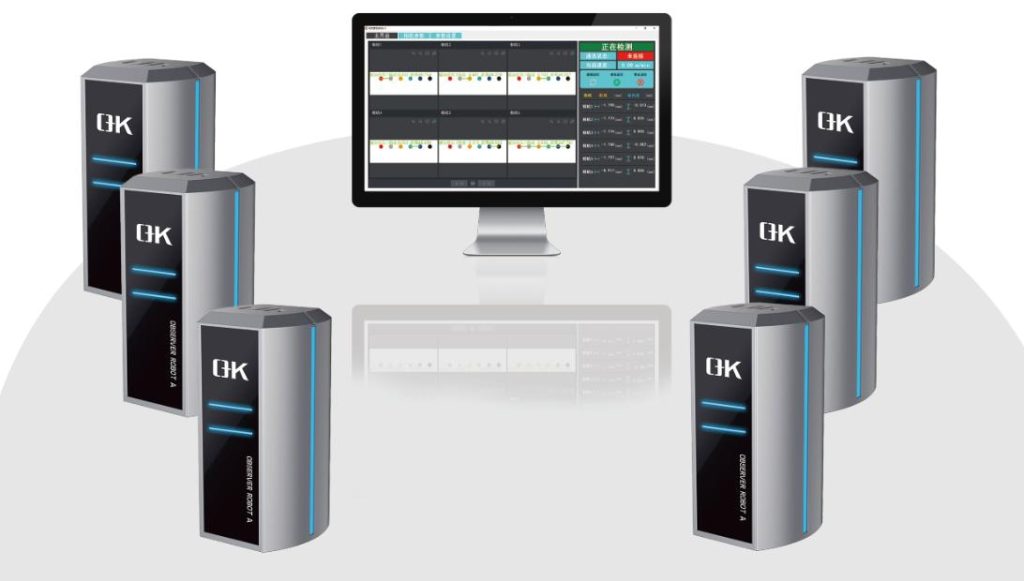
Automated registration systems are integrated directly into modern printing presses. They communicate with central control units that coordinate multiple subsystems, including ink delivery, tension control, and drying processes. This integration ensures that registration adjustments do not conflict with other operational parameters. In advanced setups, registration data may also be shared with broader production monitoring systems, enabling centralized quality control across multiple machines or production lines.
Applications of Automated Registration in Printing Inspection
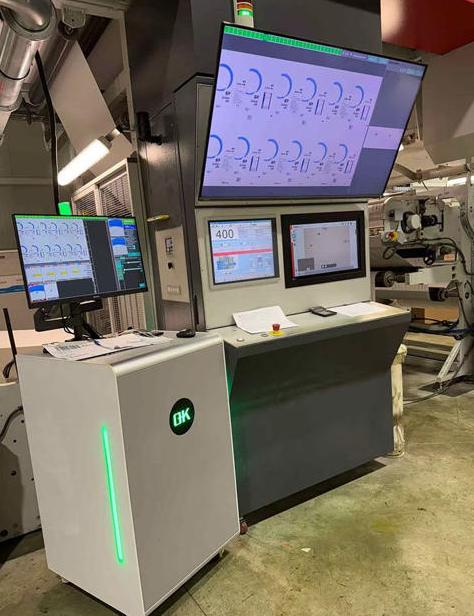
Automated registration in print inspection is widely used across multiple sectors.
| Application Area | Printing Type | How Automated Registration Is Used | Resulting Benefit |
| Packaging Industry | Flexible packaging, cartons, folding boxes | Aligns multi-layer graphics, logos, and safety information during high-speed production | Improves visual quality and reduces rejected batches |
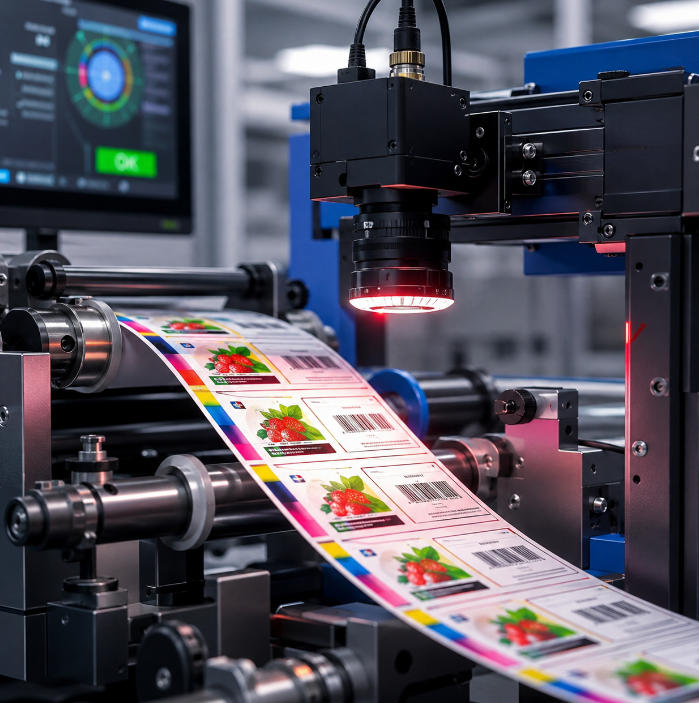
| Label Printing | Adhesive labels, product stickers, barcode labels | Maintains alignment between text, barcode, and background layers | Reduces barcode errors and enhances traceability |
| Commercial Printing | Magazines, catalogs, brochures, posters | Synchronizes multi-color image layers and page layout elements | Produces sharp, professional print quality |
| Security Printing | Banknotes, passports, certificates, tickets | Detects and corrects micro-level misalignment in complex patterns | Enhances document security and authenticity |
| Newspaper Printing | High-speed newspaper production | Continuously adjusts alignment during rapid roll-fed printing | Reduces blur and misprint rates |
| Textile Printing | Fabric printing, patterned textiles | Aligns repeating patterns across fabric rolls | Improves aesthetic uniformity in textiles |
| Flexible Electronics Printing | Printed circuits, RFID tags, smart labels | Controls layer-to-layer alignment of conductive inks | Improves product reliability and performance |
| Food & Beverage Packaging | Wrappers, cartons, bottle labels | Aligns branding elements with packaging geometry | Enhances consumer perception and brand consistency |
| Pharmaceutical Packaging | Blister packs, medicine boxes, inserts | Ensures precise placement of dosage info and regulatory text | Reduces risk of labeling errors |
| Industrial Printing | Technical manuals, instruction sheets, technical diagrams | Keeps multi-page and multi-color technical content aligned | Reduces production defects and reprints |
Challenges of Automated Registration in Print Inspection
| Challenge | Description | Root Cause | Impact on Production | Possible Solutions |
| High initial investment | Automated registration systems require advanced cameras, sensors, and control software | Cost of precision imaging and real-time control technology | High setup cost limits adoption in small and medium printing facilities | Phased implementation or modular system upgrades |
| Complex system calibration | Requires precise tuning for different materials, inks, and machine types | Variation in substrates, printing methods, and production speeds | Incorrect calibration leads to inaccurate alignment detection | Standardized calibration protocols and automated setup tools |
| Sensitivity to environmental conditions | Performance can be affected by lighting, dust, vibration, and temperature changes | Industrial production environments are unstable | Reduced detection accuracy or false readings | Controlled lighting systems and vibration isolation |
| Integration with legacy equipment | Older printing machines may not support digital feedback systems | Lack of modern control interfaces in older presses | Limited automation capability or partial system usage | Retrofitting with interface modules or upgrading machinery |
| Data processing latency | High-speed printing requires real-time image processing | Large data volumes from high-resolution cameras | Delayed correction signals may cause misalignment continuation | High-performance processors and optimized algorithms |
| False detection or noise errors | System may misinterpret marks or patterns as defects | Ink variation, substrate texture, or image noise | Unnecessary corrections or production interruptions | Improved AI-based filtering and advanced image preprocessing |
| Maintenance complexity | Systems require frequent maintenance and updates | Precision optical and electronic components degrade over time | Downtime and increased operational costs | Predictive maintenance and scheduled calibration |
| Operator skill requirements | Staff must understand both mechanical and digital control systems | Complexity of integrated automation systems | Improper operation or inefficient system use | Training programs and user-friendly interfaces |
Final Thoughts
Automated registration during print inspection is now a core pillar of today’s printing practice. It keeps alignment accurate while things are running, which helps improve product quality, shrink waste, and increase throughput. As printing inspection machine keeps moving toward full automation, registration technology will be more and more important for consistent high-quality output across industries.