
How to Select the Right Inspection Width for a Web Print Inspection System
When choosing a web printing inspection system, the inspection width is one of the key specifications that need to be determined at an early stage. However, it does not necessarily equal the maximum roll width of the printing machine.
For example, a 1200mm wide web, the actual printing area might only be 900mm. For other applications, it might be necessary to inspect the entire 1200mm web because defects outside the printing area can also affect product quality.
Therefore, one should first determine the area to be inspected and the type of defects, and then configure an appropriate inspection width based on this.
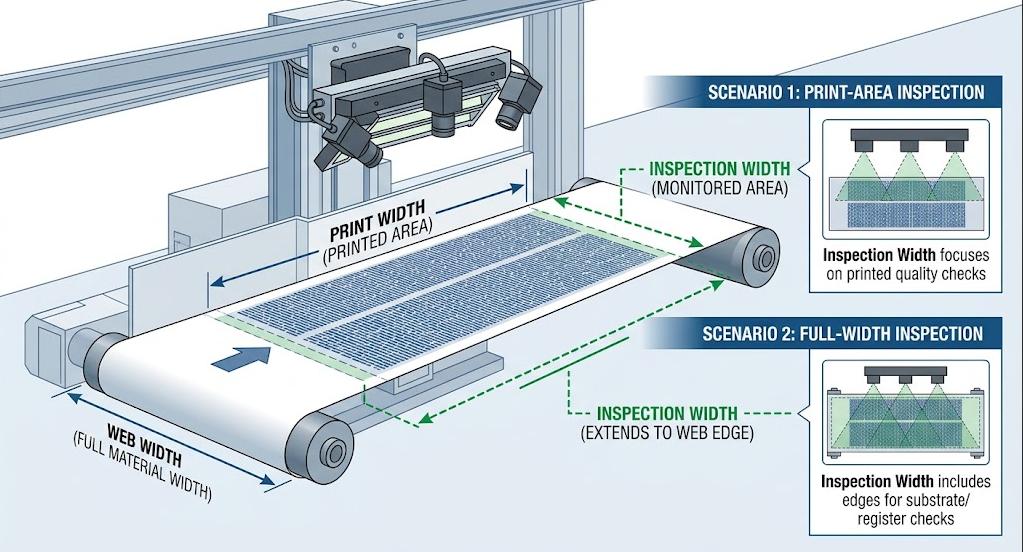
Table of Contents
What Inspection Width Does a Print Inspection System Actually Need?
The detection width refers to the effective width of the web monitored by the printing inspection system. It needs to be determined in conjunction with the width of the web, the printing width, and the actual quality control area.
These dimensions may not be the same:
| Specification | Meaning | Example |
| Web width | Maximum material width running through the machine | 1,200 mm |
| Print width | Area containing printed content | 900 mm |
| Inspection width | Area monitored by the inspection system | 900–1,200 mm |
| Minimum defect size | Smallest defect that must be detected | 0.5 mm |
If only the printed content is inspected, the detection width may be close to the printing width; if defects in the substrate, edge damage or contamination need to be detected as well, a wider detection range is required.
Therefore, the first thing to determine is not “How wide is my web? “, but “What range of detection is needed for my web? “
Match the Inspection Width to the Area You Need to Inspect
The detection area should be determined based on the actual quality requirements of the finished product.
For example, in a 1000-millimeter wide web, 800 millimeters are the printing area. If the remaining 200 millimeters do not contain quality-critical information and do not require detection, then covering the entire 1000 millimeters might not be necessary.
However, in the following situations, expanding the detection range might be more appropriate:
- Edge defects can affect cutting or rewinding;
- Surface contamination may occur outside the printing area;
- The printing positions of different operations may change;
- Multiple production lines are arranged on the web;
- The customer requires comprehensive surface detection;
- The unprinted areas contain coatings or other functional materials.
Defining the detection area helps manufacturers avoid choosing the detection system based solely on the maximum mechanical width of the production line.
When Should You Choose Full-Width Web Inspection?
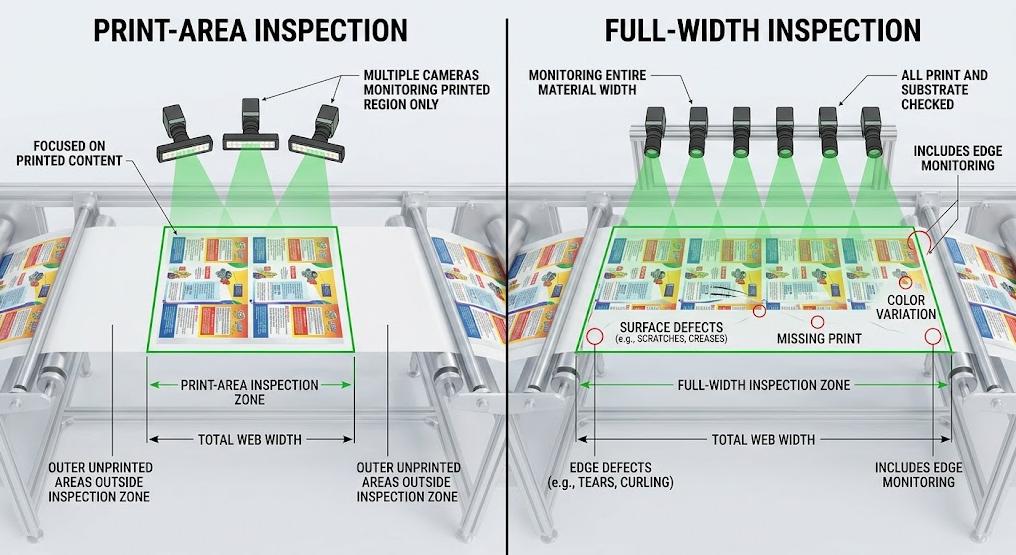
When defects at any location on the material can affect the quality, full-area inspection becomes particularly important.
It is especially applicable in the following situations:
- The quality of the entire substrate is crucial. Some products require simultaneous inspection of both printed and non-printed areas because material defects may affect downstream processing or final use.
- Edge quality is critical. Defects at the edge of the roll may affect cutting, rewinding, compounding, or other processing.
- Product layouts vary. When different printing operations use different positions or widths, full-area inspection can reduce the risk of missing critical areas.
- Full inspection is required. For applications that require 100% surface inspection, the inspection range should cover the defined quality control areas, not just the central printing area.
However, full-area inspection is not always necessary. If quality requirements are limited to stable and clearly defined printing areas, inspecting specific areas can sometimes be more practical.
How Web Width, Defect Size, and Line Speed Affect Print Inspection
The detection width is only one part of the system specifications. It is necessary to consider the minimum defect size and production speed as well.
| Requirement | Possible impact on system design |
| Wider inspection area | May require additional camera coverage |
| Smaller defect size | Requires sufficient image resolution |
| Higher line speed | Places greater demands on imaging and processing |
| More production lanes | Requires coverage across all relevant lanes |
| Variable web widths | May require a more flexible camera configuration |
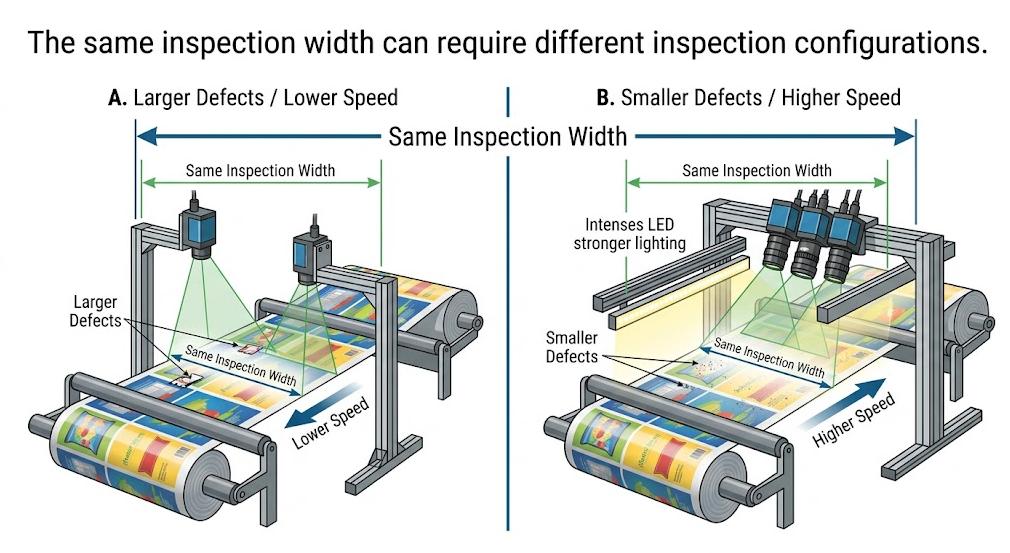
Suppose the detection width of both production lines is 1200 millimeters. One line needs to detect defects larger than 2 millimeters at a medium speed, while the other line needs to detect defects of 0.5 millimeters at a high speed.
Although the detection width is the same, the requirements for cameras, optics, lighting, and processing capabilities of the two systems may be completely different.
Therefore, the detection width cannot be determined independently of the specific detection requirements.
When a Wider Print Inspection System Is Worth the Extra Coverage
The expansion of the detection width should be based on measurable production requirements.
The following situations may require a wider detection system:
- Future products will adopt wider web sizes. If only the current production requirements are considered, the size of new products may be restricted when added.
- Defects near the edges of the web are crucial. These defects may not be within the main printing area, but they can still affect subsequent processing.
- Product layouts change frequently. A wider detection range can reduce the need for operators to reconfigure the detection area for different operations.
- Multiple production lines are operating simultaneously. The complete production layout needs to remain within the detection range.
On the contrary, if the printing area is fixed, other web sizes are not within the quality control scope, and future production requirements do not change significantly, then there is no need to expand the detection range.
Therefore, the best solution is not to choose the widest possible detection system, but to determine the most effective detection range based on actual needs.
How to Specify Inspection Width When Choosing a Web Inspection System
Before requesting the supplier to configure the web inspection system, it is recommended to prepare the following information:
- Maximum and minimum web width
- Typical production web width
- Actual printing width
- Required inspection area
- Minimum defect size
- Maximum production line speed
- Number of scanning lines
- Base material and surface characteristics
- Single-sided or double-sided inspection
- Future product width requirements
For example, instead of only providing:
“Our web width is 1200 millimeters.”
It is better to provide:
“Our maximum web width is 1200 millimeters, the printing area is approximately 950 millimeters, the maximum production line speed is 400 meters per minute, and defects as small as 0.5 millimeters need to be detected.”
These pieces of information can help the supplier determine the inspection range and camera configuration more accurately.
Final
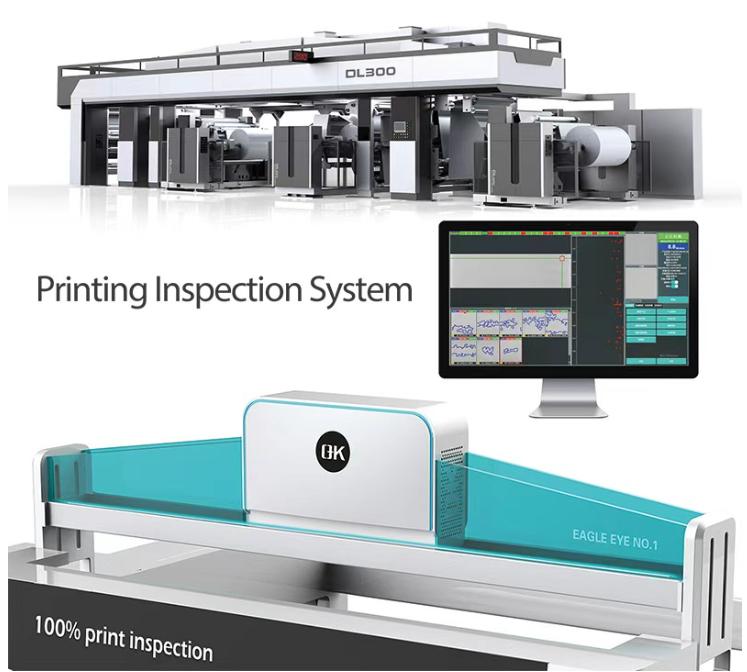
The appropriate detection width should meet the actual quality requirements while avoiding unnecessary increase in system complexity. Before determining the specifications, factors such as the width of the sheet material, the printing area, the minimum defect size, the production line speed, the channel layout, edge requirements, and future production needs should be comprehensively considered.
The Arise printing inspection system can be flexibly configured according to the web width, detection requirements, and production conditions, and is equipped with suitable cameras and lighting systems to achieve reliable 100% inspection. After providing the web width, production line speed, substrate, and the minimum defect size to be detected, Arise can help you determine the appropriate detection width and system configuration.