
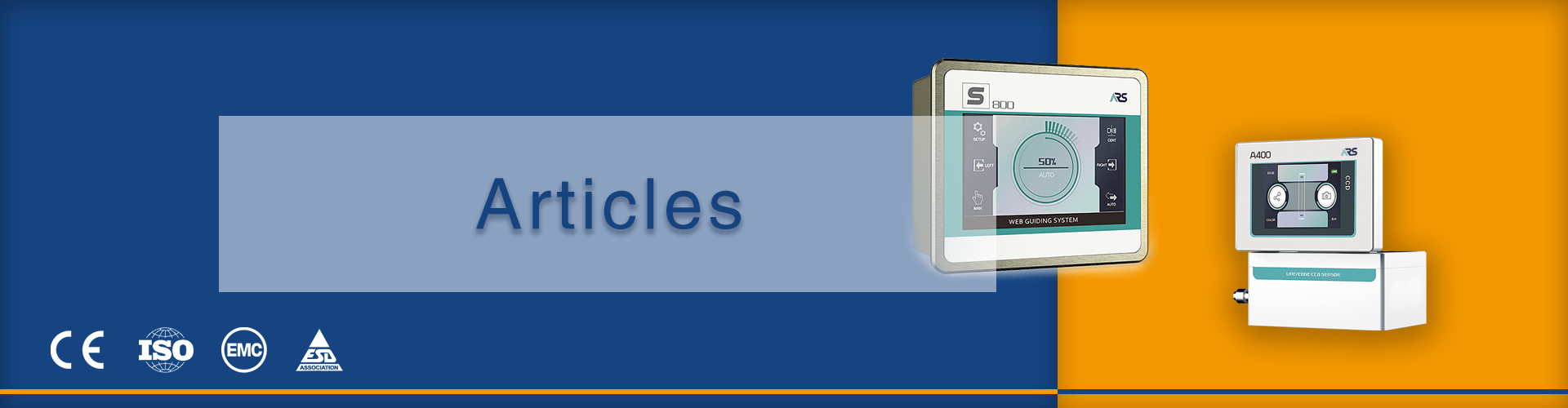
From Frequent Downtime to Round-the-Clock Stable Operation: How an Indian Label Machinery Manufacturer Optimized Its Web Guiding System
The label printing and flexographic packaging industries demand extremely high register accuracy. Even tiny deviations can scrap an entire production batch. During high-speed operation, web wandering, lost edge tracking and sensor signal interference are the most common sources of line failures.
Drawing on real-world optimization experience from an Indian label machinery manufacturer, this article systematically analyzes web guiding system selection logic and key commissioning tips, helping enterprises facing similar challenges identify practical solutions.
Table of Contents
A Common Yet Easily Overlooked Problem
An Indian label machinery manufacturer, which mainly produces flexographic presses and automatic slitter rewinders for local packaging printing converters, frequently encountered the following issues during line commissioning:
- Unstable web edge tracking; frequent loss of sensor signals especially when processing ultra transparent films.
- Lagging web guiding response at high speed (>600 m/min), with lateral web offset exceeding allowable tolerance.
- Controllers required inverted installation in compact spaces, while the screen display orientation could not adapt to such mounting.
- Operators needed lengthy training to master commissioning procedures, extending equipment delivery lead time.
These troubles directly caused delayed equipment deliveries, higher on site commissioning costs and reduced customer satisfaction. This is not an isolated case. Many Indian label equipment builders and end user packaging firms face comparable challenges. As the “invisible guardian” of the production line, an improperly selected or mis configured web guiding system will drag down the efficiency of the entire line.
Optimization Strategy: Diagnose First, Select Second
Prior to upgrading the web guiding system, the equipment manufacturer carried out systematic problem diagnosis together with the ARISE technical team.
Step 1: Sort out web guiding requirements for each process
| Process / Equipment | Material Type | Line Speed | Mounting Method | Key Pain Points |
| Unwinding & rewinding of label printing press | Label paper, film | Medium high speed | Standard mounting | High precision edge tracking required |
| Automatic slitter rewinder | Various web materials | Medium speed | Variable left right material outlet | Cutting accuracy relies heavily on stable web guiding performance |
| Special purpose machine models | Multiple material types | Medium high speed | Inverted installation with limited space | Standard controllers cannot meet mounting requirements |
Step 2: Evaluate Shortcomings of the Original System
Improper sensor selection: Ultrasonic sensors were not deployed for ultra transparent materials, resulting in signal penetration failure.
Insufficient controller response speed: Torque decay of the stepper system at high speed operation leads to delayed web guiding action.
Lack of customization capability: Requirements such as inverted installation and screen flipping could not be fulfilled.
Complicated HMI: Excessive commissioning parameters demanded lengthy training for field engineers.
Step 3: Match Product Solutions According to Process Requirements
Based on the diagnosis results, Arise allocated tailored products for each process to cover the demands of the manufacturer’s mainstream machine models.
Web Guiding Selection Principles for Different Production Lines
Optimization experience from this equipment manufacturer can be summarized into the following general selection principles, applicable to most label printing and flexographic packaging production lines:
Principle 1: Select Sensors Based on Material Properties, Not Price
This is one of the most frequent selection misconceptions. Different materials place entirely different demands on sensors.
| Material Type | Recommended Sensor | Reason |
| Paper & printed non transparent webs | Infrared A100 | Cost effective and reliable detection |
| Transparent / ultra transparent films | Ultrasonic A200 | Acoustic wave penetration independent of material transparency |
| Perforated materials (non woven fabric, gauze) | Infrared A100 (with tab filter function) | Filter interference signals caused by mesh holes |
| Outlet section of high temperature oven | Fiber optic A300 | Withstands 350 ℃; no additional cooling required |
Principle 2: Servo Motor with Encoder Feedback Is Mandatory for High‑Speed Lines
Stepper motors work satisfactorily at low‑speed conditions (<300 m/min). Featuring low cost, they fit standard unwinding and rewinding applications.
Servo motor plus encoder feedback delivers fast response and high accuracy for medium‑to‑high‑speed scenarios (300‑1200 m/min), ideal for high‑speed film and label printing lines. The encoder feeds back screw position in real‑time, and closed‑loop control guarantees consistent accuracy.
Principle 3: Non‑Standard Mounting Is a Core Competency, Not a Bonus Feature
Many suppliers only offer standard‑mount models, forcing machinery builders to compromise mechanical design to accommodate controller dimensions and orientation.
Customization options supported by ARISE (Chongqing Enruisi):
- Inverted installation
- 180° screen flipping
- Left‑hand / right‑hand material outlet switching
- External controller (for space‑saving installation)
Principle 4: Simplified HMI Speeds Up On‑Site Delivery
For Indian machinery manufacturers, shorter operator training translates directly to lower costs. Touch‑screen with English UI and preset parameter templates allow operators to finish basic setup within 10 minutes.
Typical Configuration Adopted by the Equipment Manufacturer
Following systematic diagnosis and solution matching, the Indian machinery factory deployed the product combinations below (all are real world applied models for conventional flexo lines, high speed film machines and units with special space constrained mounting requirements):
- Conventional flexographic lines: N180 controller + USA200 sensor + SE series drive, fulfilling supporting requirements for multiple standard machine models.
- High speed label printing lines: S800 servo controller + USA200 sensor + servo drive, delivering stable web guiding performance above 600 m/min.
- Special mount machines (inverted / space limited installation): S800 160 mm (180° flipped screen mounting) + USA200, tailored for compact machinery.
- Automatic slitter rewinder: W series slitter web guiding system with selectable left hand / right hand material outlet to satisfy different discharging direction requirements.
- Tension control: T300 English UI tension controller + LS200 through shaft tension sensor to guarantee closed loop stable web tension.
- Configuration logic: Instead of applying a one size fits all setup across all machines, the manufacturer selected different product combinations according to line speed, mounting space, material outlet direction and other parameters.
This represents the core methodology for web guiding system selection: there is no universally “best” model, only the solution best suited to your working conditions.
Practical Results After Optimization
Thanks to systematic solution selection and joint commissioning support, the web guiding system performance of this machinery manufacturer has been greatly improved:
- Improved signal stability: No frequent loss of edge tracking signals when processing ultra transparent films with ultrasonic sensors.
- Qualified high-speed response: The servo and encoder solution synchronizes web guiding response with production speed increase, supporting a maximum line speed of 1200 m/min.
- Lower mounting adaptation costs: Non-standard customization enables controllers to perfectly fit compact layout machines without modifying host mechanical structures.
- Higher delivery efficiency: English-language touch screen plus preset parameter templates shorten training cycles for field engineers.
Technical Recommendations for Indian Label Machinery Manufacturers & Packaging End Users
Drawing on practical insights from this case study, here are key points for Indian label machinery builders and packaging end users to consider when evaluating and selecting web guiding systems:
1. Clarify material parameters and working conditions in advance
Before sending RFQs to suppliers, confirm the following specifications: maximum / minimum web width, material transparency, maximum line speed, existence of high temperature zones and electrostatic prone environments. More detailed information enables more accurate supplier recommendations.
2. Treat anti interference performance as a mandatory requirement
Static electricity and frequency converter interference, commonly seen in Indian factories, are the “hidden killers” for web guiding systems. Prioritize models with EMC certification and documented anti static performance. All ARISE sensors operate reliably under 30 kV electrostatic discharge and high power frequency converter interference.
3. Prefer suppliers with comprehensive product portfolios
A complete web guiding solution consists of controllers, sensors, drives and guiding frames. Choosing one supplier capable of full set supporting reduces coordination work among multiple vendors and ensures consistent after sales support.
4. Pay attention to non standard customization capability
If your machine has limited space or special mounting requirements, verify beforehand whether non-standard mounting options are available: inverted installation, 180 degree screen flipping, left right material outlet switching and others. When standard products cannot fit mechanical constraints, customization becomes a core competitive advantage.
5. Take long term maintenance costs into account
Features such as maintenance free ground ball screws for lifetime service and LED light sources with no bulb replacement requirement may seem minor, yet they can substantially cut operational costs over the full equipment lifecycle.
Why ARISE (Chongqing Enruisi) Is the Long-Term Preferred Supporting Supplier for Equipment Manufacturers
The core strengths demonstrated by ARISE in this cooperation case are exactly the key evaluation criteria that Indian label machinery factories and packaging enterprises should prioritize when screening suppliers:
1. Technical Qualifications & Credentials
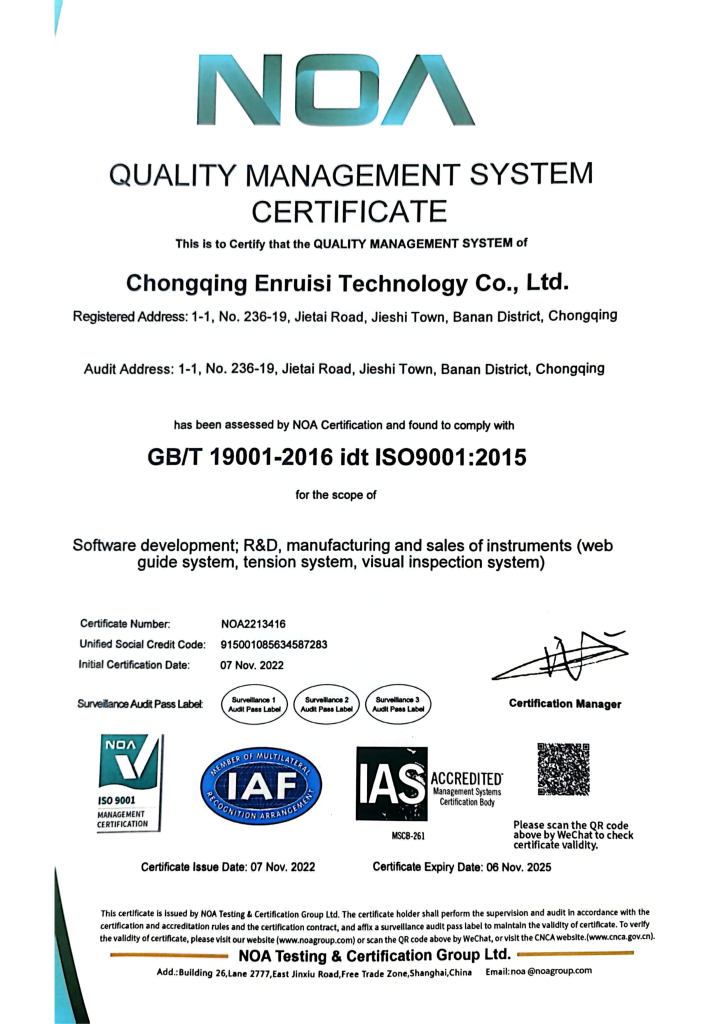
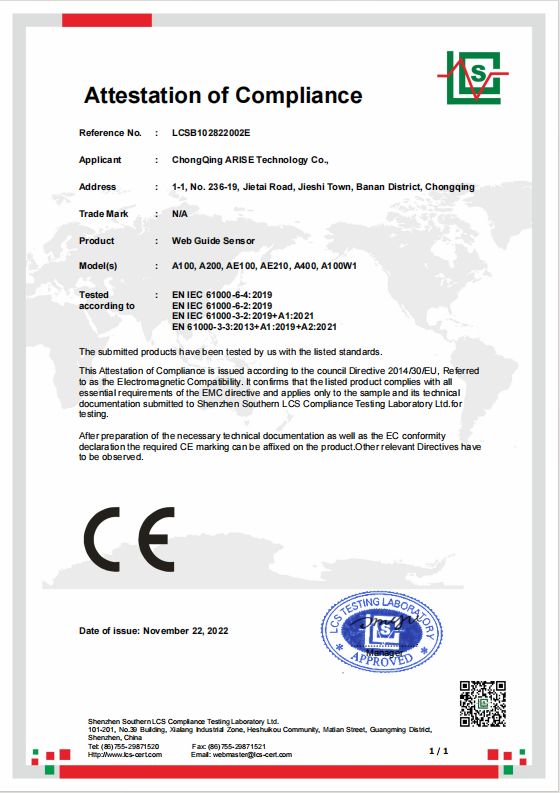
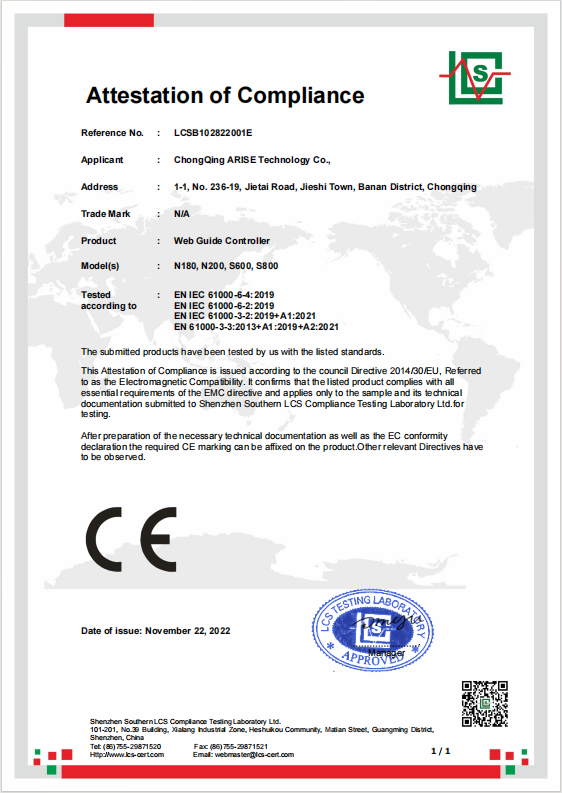
With 25 years of experience in web control solutions, ARISE’s products are certified with EU CE, EMC Electromagnetic Compatibility and ESD Anti-Static certifications. The company holds a total of 6 invention patents, 11 utility model patents, 26 design patents and 18 software copyrights, and is officially recognized as a national Specialized, Refined, Differential & Innovative “Little Giant” enterprise.
Compliance Credentials & Export Support
Domestic Qualifications
- ISO 9001 Quality Management System Certification
- Integration of Informatization & Industrialization Management System Certification
- National High-Tech Enterprise Accreditation
- Chongqing Municipal SRDI “Little Giant” Enterprise Accreditation
International Certifications
- EU CE Safety Certification
- EMC Electromagnetic Compatibility Certification
- ESD Anti-Static Certification
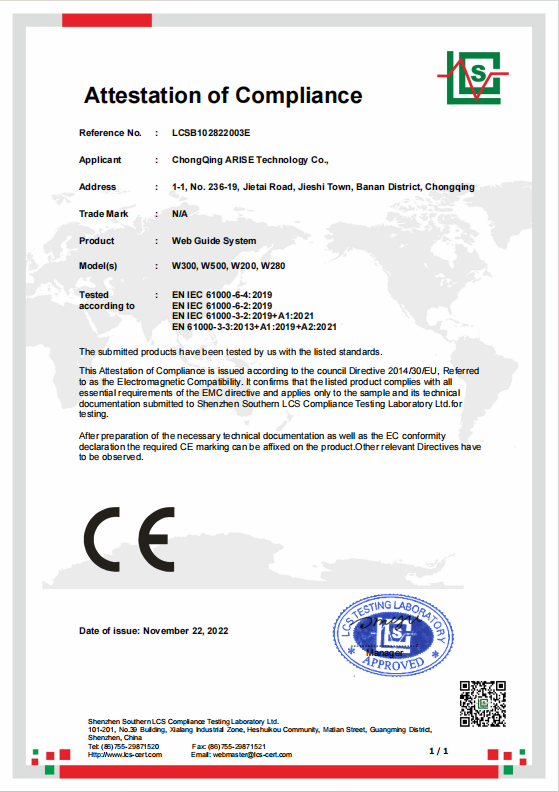
Official Query Portals for Credentials
- ISO 9001: National Public Service Platform for Certification & Accreditation Information (http://cx.cnca.cn)
- SRDI “Little Giant” Enterprise: MIIT Gradient Cultivation Platform for High-Quality SMEs (https://zjtx.miit.gov.cn/zxqySy/main)
- CE / EMC Certifications: EU NANDO Notified Body Database (https://ec.europa.eu/growth/tools-databases/nando/)
Digital copies of all complete certificates are available free of charge upon request from our sales team.
2. Full-Range Complete Product Line
Our product portfolio covers the entire web control workflow:
- Tension controllers: Cost-effective N series & high-performance servo S series
- Sensors: Ultrasonic, infrared and fiber-optic sensors
- Drives: Stepping & servo drivers
- Web guiding frames
- Auxiliary inspection systems: Visual inspection, width measurement, thickness measurement, static image monitoring and coating defect tracking systems
3. Customization & Stable Mass Delivery
- Customized non-standard solutions supported: inverted installation, screen image flipping, left/right material outlet switching and other personalized modifications
- Consistent product performance and reliable lead time guaranteed for bulk orders
4. Global Service Network
Our service network covers more than 150 countries and regions worldwide. We have an office in Vietnam and a subsidiary in Indonesia, enabling full coverage of the Indian market to deliver timely technical support and spare parts supply.
A web guiding system acts as the “steering wheel” of web production lines. Compact in size, yet it defines the accuracy and efficiency of your entire production line.
As demonstrated by the optimization case of the Indian label machinery manufacturer, web guiding solution selection should never be price driven alone. Three core dimensions deserve priority consideration: matching sensors to materials, matching controllers to production speed, and matching mounting solutions to physical space constraints.
With 25 years of accumulated expertise in web control technology, a comprehensive web guiding product portfolio and Southeast Asia centered service network, ARISE (Chongqing ARISE Technology Co., Ltd.) delivers end-to-end support for the Indian market, ranging from selection consultation through to mass volume delivery.